
A calm, practical guide from someone who lived on Okinawa Main Island
Okinawa usually has a relaxed rhythm.
The sea is bright.
The sky feels wide.
People move slowly, and travel plans often feel soft and easy.
But when a typhoon approaches, the rhythm of Okinawa changes.
Supermarkets get busier.
Department stores and shops may announce early closures.
Buses and the Yui Rail may stop running.
Flights and ferries may be cancelled.
And local people, who usually seem calm and relaxed, begin to move quickly.
This article is written from the perspective of someone who lived on Okinawa Main Island.
It is mainly for travelers staying on the main island — especially around Naha, Onna, Chatan, Nanjo, Uruma, and other areas reachable by car or public transport.
I cannot speak in detail about the remote islands.
On smaller islands, ferry schedules, food supplies, accommodation options, and recovery after a typhoon can be very different.
So please read this as a calm, practical guide for Okinawa Main Island.
And most importantly: always follow official weather warnings, your hotel’s guidance, and local instructions first.
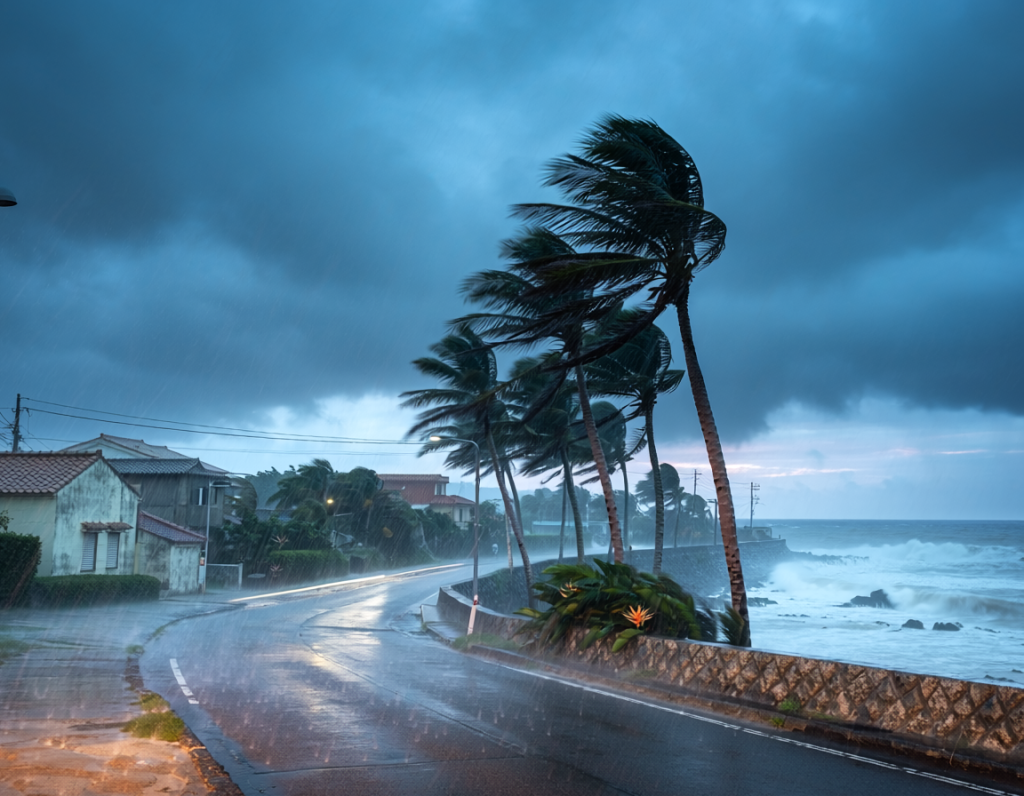
First, understand typhoon season in Okinawa
Okinawa is more exposed to typhoons than many parts of mainland Japan.
Typhoons mainly affect Okinawa from around June to September, and official tourism information recommends checking the weather before and during your trip. The Japan Meteorological Agency also shows that tropical storms approaching the Okinawa region peak in August, based on normal climate statistics.
This does not mean every summer trip will be affected.
Many travelers visit Okinawa during summer and have beautiful weather.
But if you are traveling between summer and early autumn, it is better not to check the weather only once.
Check it before your trip.
Check it again after arriving.
And if a typhoon appears near Okinawa, check updates more than once a day.
The weather can change quickly, and travel decisions may need to be made earlier than you expect.
A local note: when Okinawa people start moving quickly
When I lived in Okinawa, one thing I noticed was this:
People in Okinawa may seem relaxed in daily life, but when a typhoon is coming, they move quickly.
They buy food early.
They check shop closures early.
They think about transportation early.
They secure what they need before the wind becomes serious.
As a traveler, this is important.
If you notice local people preparing earlier than you expected, follow that rhythm.
Do not wait until the last minute.
A typhoon day in Okinawa is not a day to “see how it goes.”
It is a day to prepare early, stay flexible, and make the safest choice before the weather becomes difficult.
Watch department stores, supermarkets, and early closures
On Okinawa Main Island, department stores and supermarkets often announce temporary closures or shorter business hours when a strong typhoon approaches.
For example, places like department stores, shopping centers, and local supermarkets may close earlier than usual. This is not something to ignore.
If shops begin announcing early closures, it is time to stop thinking, “I still have time.”
Buy what you need before the weather becomes serious.
For travelers, this usually means:
- drinking water
- simple food
- snacks
- medicine
- batteries or chargers
- anything you need for children or health conditions
- simple meals that do not require cooking
Convenience stores may still be open for a while, but they can become crowded.
Popular items may disappear quickly.
If you need food, do not wait until night.
The “Union supermarket” sign — a local, unofficial clue
There is a supermarket chain in Okinawa called Union.
When I lived in Okinawa, Union had a reputation for staying open during typhoons more often than other stores. Many people in Okinawa know this feeling.
So if Union becomes extremely crowded, shelves start emptying, or Union announces a temporary closure, some locals take it as a sign that the typhoon may be serious.
I once heard people say something like:
“If even Union closes, this one is really coming.”
This is not an official safety rule.
It is only a local, personal sign I noticed while living on Okinawa Main Island.
You should never use it instead of official weather warnings.
But as a traveler, it can help you understand the local atmosphere.
If local people are shopping quickly and shelves are becoming empty, it is time to prepare calmly and seriously.
Buy food and water earlier than you think
Before a typhoon, supermarkets and convenience stores can become crowded.
Bread, instant noodles, rice balls, bottled water, snacks, and ready-to-eat foods may sell out quickly.
OIST’s typhoon preparation guidance also recommends preparing enough food and water for a few days, charging devices, clearing balconies, and filling the bath with clean water before a typhoon arrives.
If you are staying in a hotel, prepare at least:
- water
- snacks
- simple food
- a charged phone
- a power bank
- medication you need
- something easy to eat if restaurants close
If you are staying in an apartment, Airbnb, or weekly rental, you may want to prepare a little more:
- drinking water
- simple food for one or two days
- frozen water bottles
- towels or newspaper for windows
- a full bathtub of water, if possible and appropriate
The point is not to panic-buy.
The point is to avoid being unprepared when shops close and transportation stops.
Prepare for power outages and no air conditioning
One thing travelers may not expect is the heat during and after a typhoon.
If the power goes out, air conditioning may stop.
If strong wind damages an outdoor air conditioner unit, the room may become hot even after the main storm has passed.
If you have access to a freezer, one useful local preparation is to freeze large bottles of water before the typhoon arrives.
For example, freezing 2-liter plastic bottles can help in two ways.
First, they can help keep food cold inside the refrigerator or cooler if the power goes out.
Second, they can help you cool your body if the room becomes hot and the air conditioner is not working.
If you are staying in a hotel, you may not be able to do this.
In that case, ask the front desk what to do if there is a power outage.
Do not assume that everything will stay normal just because you are staying in a modern building.
Fill the bathtub with water if you are staying in an apartment
If you are staying in an apartment, Airbnb, or private rental, and it is safe and allowed to do so, fill the bathtub with water before the typhoon arrives.
This water is not for drinking.
It may be useful for flushing the toilet, simple washing, or emergency use if water service is affected.
This is a common typhoon preparation in Okinawa, and OIST’s typhoon preparation guide also includes filling the bath with clean water.
If you are staying in a hotel, ask the hotel staff what they recommend.
Hotels usually have their own procedures, and it is better to follow their instructions.
Wind-driven rain can come through balcony windows
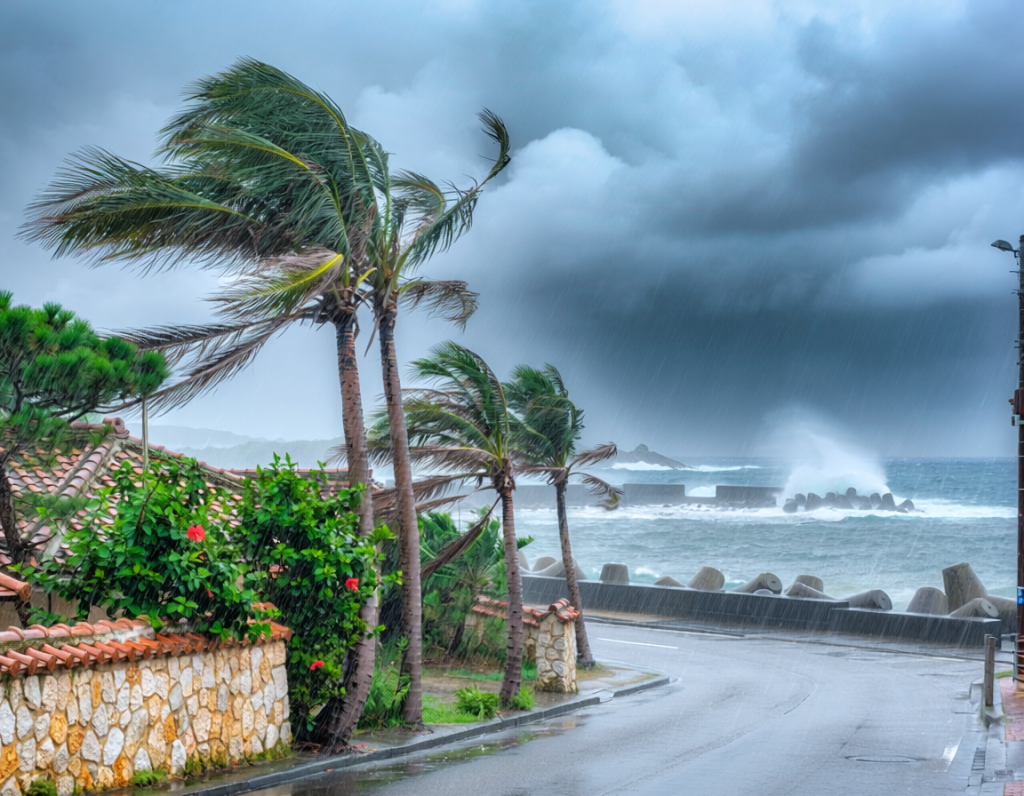
Okinawa typhoons can bring rain that feels like it is coming sideways.
If your room has a balcony, rain may sometimes come through the window frame or sliding door area, especially when strong wind pushes rain toward that side of the building.
If water starts coming in, place towels, newspaper, or absorbent cloths along the window frame.
Do this early, before the floor becomes wet.
Also, if you have anything on the balcony, bring it inside before the wind becomes strong.
Small items can become dangerous in typhoon winds.
If you have a rental car, park carefully
If you are renting a car in Okinawa, be very careful during a typhoon.
Strong wind can make driving dangerous.
Road conditions can worsen.
Coastal roads, bridges, and exposed areas may become especially risky.
Visit Okinawa Japan also notes that typhoons can affect flights, ships, buses, monorails, roads, taxis, and driving conditions.
If you have to park your rental car, try to park it somewhere less exposed to direct wind if possible.
Also be very careful when opening the car door.
A sudden gust can pull the door open strongly.
This can damage the car, hit another vehicle, or injure someone.
If you do not need to drive, do not drive.
A typhoon day is not a sightseeing day.
Download Windy before you need it
When I lived in Okinawa, I often looked at Windy more than a normal weather app during typhoon season.
Windy is useful because it shows wind, waves, and weather patterns visually on a map. The service describes itself as a platform for wind, waves, and weather forecasts.
For travelers, the free version may be enough.
It can help you understand:
- where strong wind is moving
- how the typhoon is approaching
- whether wind direction is changing
- what the sea conditions may look like
However, Windy is not a replacement for official warnings.
Use it together with official sources such as the Japan Meteorological Agency, your airline, your hotel, and local government information.
I recommend downloading it before your trip, or at least before a typhoon approaches.
Do not wait until the last train, bus, or taxi
If a typhoon is approaching, do not plan your movement too tightly.
Do not think:
“I’ll just go back to the hotel later.”
Public transportation can stop earlier than expected.
Buses and monorail services may be suspended during a typhoon, and road conditions can make taxis or driving difficult.
This means:
- go back to your hotel earlier
- buy food earlier
- return your rental car earlier if needed
- check transport updates early
- do not leave important movement until evening
Okinawa may feel relaxed, but typhoon preparation is not relaxed.
Move early.
Flights may still be disrupted after the sky clears
One thing to remember about typhoons in Okinawa is that travel may not return to normal immediately.
Even if the sky becomes blue again, flights can still be delayed or cancelled.
This can happen because of aircraft positioning, crew scheduling, previous cancellations, airport operations, or the path of the typhoon itself.
So if your flight is cancelled, delayed, or changed to a conditional flight, do not wait too long before thinking about accommodation.
Naha Airport may operate flights late at night in some situations, especially when delays happen.
But the passenger terminal and airport services are not something you should assume are comfortably open 24 hours in the same way.
Some areas, counters, information desks, shops, and services have limited opening hours.
In other words, Naha Airport is not a place where I would plan to spend the night.
If you realize that you may need to stay in Okinawa one more night, try to secure a hotel as early as possible.
When many flights are cancelled at the same time, hotels in Naha, near the airport, and around central Okinawa can fill up quickly.
It is much easier to make a calm decision while you still have time.
Check your airline’s official website or app.
Contact your current hotel and ask if you can extend your stay.
Look for another room before you are already tired at the airport.
After a strong typhoon, flight disruptions may continue for another day or even a few days.
If your schedule allows it, give yourself more room than you think you need.
A flexible extra night can make the situation much less stressful.
What not to do during an Okinawa typhoon
There are a few things you should not do during a typhoon in Okinawa.
Do not go to the beach just to see the waves.
Do not drive unless you really need to.
Do not wait until the last minute to buy food.
Do not assume buses, monorails, taxis, or flights will run normally.
Do not ignore shop closures.
Do not treat a typhoon day as a sightseeing day.
Visit Okinawa Japan also advises travelers not to go near the sea during typhoons and to avoid unnecessary outings until warnings are lifted.
The ocean may look powerful and dramatic during a typhoon.
But it is not worth the risk.
Stay inside.
Stay informed.
Let the storm pass.
A simple checklist for travelers
If a typhoon may affect your Okinawa trip, here is a simple checklist.
Before the weather gets bad:
- check official weather information
- check your airline’s website or app
- ask your hotel for advice
- buy water and simple food
- charge your phone and power bank
- bring balcony items inside
- prepare cash if possible
- check bus, monorail, ferry, and rental car updates
- avoid unnecessary travel
- stay away from the sea
If you are staying in an apartment:
- freeze water bottles if you can
- fill the bathtub with water if allowed
- prepare towels for windows
- check how to contact the host
- keep emergency lights or phone lights ready
If your flight may be cancelled:
- check your airline first
- do not go to the airport without checking
- secure accommodation early
- expect crowds
- prepare for delays even after the sky clears
Final thoughts: Okinawa will still be there
A typhoon can change your Okinawa trip.
It can be disappointing, especially if you came for the sea.
You may lose a beach day.
You may miss a planned island trip.
Your flight may change.
You may need to stay inside instead of exploring.
But when Okinawa becomes serious about a typhoon, follow that seriousness.
Move early.
Prepare quietly.
Stay inside.
Give yourself more time than your original plan.
Okinawa is beautiful, but it is also an island that lives with strong weather.
The ocean will still be there after the storm.
The sky will clear again.
And your trip does not have to be perfect to be meaningful.
Sometimes, the safest choice is also the gentlest one.
Practical Information and Useful Links
For the latest information, always check official or direct sources.
- Japan Meteorological Agency
- Visit Okinawa Japan typhoon precautions
- Your airline’s official website or app
- Naha Airport flight information
- Your hotel or accommodation
- Local bus, monorail, ferry, and rental car company announcements
- Windy, together with official warnings